FAQs
Q. Where exactly was this photo taken?
Q. Are your images real or fake?
Q: Can I use or share your photos?
Q: Why don’t you use a large or intrusive watermark on your photos?
Q: Why do your prints cost more than standard photo prints?
Q: What are fine art prints?
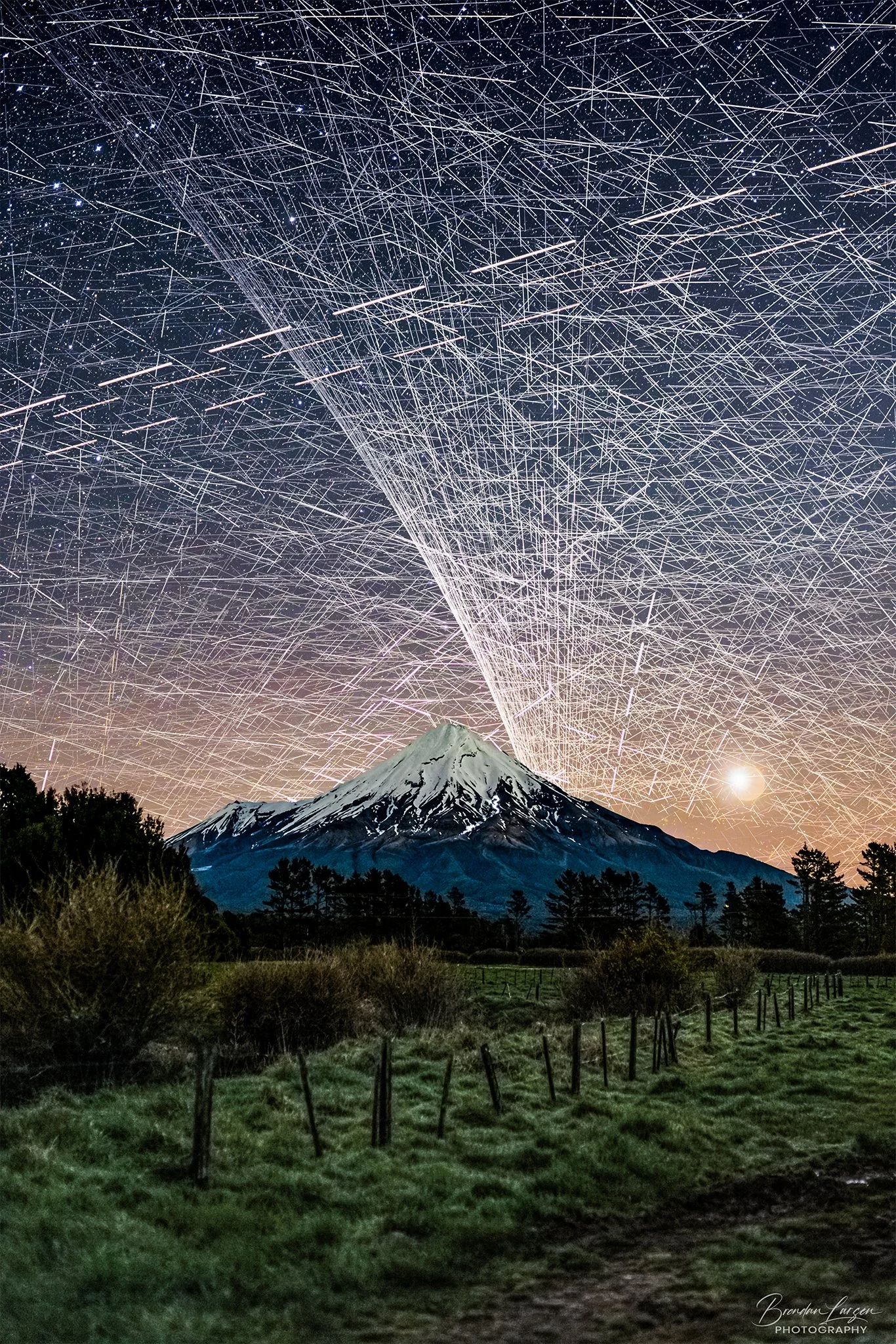
Q: 14,000 Satellites image - is it real etc…?
Q. Where exactly was this photo taken?
A. Location details aren’t always shared publicly.
Some of my photos include location details in the description, but other times I choose not to share exact locations publicly. This can be due to privacy, protecting certain places, or the significant time and effort involved in scouting and planning shots.
If you’re genuinely interested in a location for a personal reason — for example, if it’s somewhere meaningful to you or you’re considering a print — please send me a direct message rather than asking in the comments, and I’m happy to chat.
Q. Are your images real or fake?
A. All images are real photographs of real New Zealand locations.
No AI-generated skies. No fake mountains. No stock composites.
Night images use standard photography techniques (long exposure, stacking, tracking etc) to capture more detail and colour than the human eye can normally see.
What you’re seeing is a faithful representation of real moments, captured with professional equipment and careful planning.
Every alignment — Milky Way, moonrise, or star field — is planned and captured on location using astronomy planning tools, not digitally fabricated.
Q: Why don’t you use a large or intrusive watermark on your photos?
A: Large, intrusive watermarks don’t offer much real protection anymore. With modern tools like Photoshop and AI, even large watermarks can usually be removed by anyone determined to misuse an image.
The small number of people who do misuse images were never likely to pay for them anyway, while heavy watermarks significantly reduce image quality, engagement, and reach on social media — as people are less likely to engage with or share images that feel visually obstructed.
I use a small, unobtrusive watermark and retain full copyright on all my work. For me, it’s about balancing protection with reach, image quality, and the viewing experience.
Q: Why do your prints cost more than standard photo prints?
A: When you purchase one of my prints, you're not simply paying for paper and ink.
You're purchasing a finished piece of photographic artwork that represents the entire process behind creating the image.
Many of my photographs require extensive planning, travel, specialist photographic equipment, favourable weather conditions, and in the case of night-sky images, advanced techniques and equipment that go well beyond ordinary photography.
Some images represent hours of work in the field, while others are the result of multiple trips over months or even years before conditions finally align.
Once an image is captured, additional time is invested in processing, colour management, print preparation, quality control, and ensuring the final print accurately reflects the scene as photographed.
On top of this, all prints are produced as archival-quality fine art prints using premium papers and pigment inks designed for long-term display.
My goal is to create prints that are not only visually striking, but are also worthy of the time, effort, and craftsmanship that went into creating the original photograph.
Q: What are fine art prints?
A: All photographic prints sold through Brendan Larsen Photography are fine art prints.
Fine art prints are produced using premium archival papers and professional pigment inks, rather than the lower-cost materials typically used for standard retail photo printing. The result is superior colour accuracy, smoother tonal transitions, deeper blacks, and significantly improved longevity.
This is particularly important for landscape, night-sky and astrophotography images, where subtle colour gradients and fine detail can easily be lost with lower-quality printing methods.
My prints are produced by professional print labs using archival materials designed to resist fading and maintain their appearance for many years when displayed under normal conditions.
While fine art prints cost more to produce than standard photo prints, they are intended to be premium display pieces that accurately represent the original photograph and can be enjoyed for decades.
14,000 Satellite Trails over Mt Taranaki — FAQs
1. Is this photograph real, or is it AI-generated?
It's 100% real photography, not AI-generated. I captured 578 photographs over nearly two hours and manually combined them in Photoshop. The final image took approximately 45 hours to edit.
2. Why hasn't the Moon moved?
That's not the Moon — it's Venus! Venus did move across the sky during the two hours, but I kept it visible from just one photograph. Otherwise, it would have appeared repeatedly across the final image.
3. Are these really satellites, or are they aeroplanes?
Almost all the trails are satellites, predominantly Starlink. There are also two aeroplanes visible in the photograph. Aeroplanes typically produce distinctive flashing or alternating light patterns, whereas satellites reflect sunlight.
4. Why are there gaps in the satellite trails?
Each photograph was an 8-second exposure, with approximately 2 seconds between exposures while the camera wasn't recording light. The gaps represent those intervals, not satellites flashing on and off.
5. How can satellites leave trails when they're just dots in the sky?
Satellites appear as moving points of light to the naked eye. However, during an 8-second exposure, they move across the camera's field of view, leaving a streak of light.
I used a 50mm lens, which makes their apparent movement more pronounced than a typical wide-angle astrophotography lens. Some longer trails were also built up from multiple consecutive photographs.
6. Are there really 14,000 satellites in this photograph?
No. The image contains approximately 14,000 satellite trails, but that is not the same as saying there are 14,000 satellites.
I captured 578 photographs, with an average of approximately 25 satellite trails per photo. That gives an estimated 14,450 satellite trail appearances (578 × 25).
However, the same satellite often appeared in multiple consecutive photos. Having manually processed every satellite trail during 45 hours of editing, I know that individual satellites typically appeared in around 6–10 frames.
Using 10 appearances per satellite gives approximately 1,445 individual satellites (14,450 ÷ 10).
My estimate is therefore approximately 1,400 individual satellites captured over nearly two hours.
7. Why are satellites travelling in different directions, and why do their trails form an arc pattern?
Satellites orbit Earth along different paths and at different angles, so they can appear to travel in many directions across the sky.
The distinctive sweeping, arc-like pattern is largely a result of perspective. Many Starlink satellites follow similar orbital paths, but from our viewpoint on the ground, their trails appear to converge towards certain areas of the sky.
It's similar to how parallel railway tracks appear to converge in the distance, even though they're actually parallel.
8. How can satellites be visible when they're so small and far away?
Satellites reflect sunlight. You don't need to resolve an object's physical shape to see light coming from it.
It's similar to seeing sunlight reflecting off a small mirror several kilometres away, even though you couldn't distinguish the person holding it.
Some satellites are bright enough to see with the naked eye, particularly shortly after sunset or before sunrise.
9. How did you create this photograph, and why did it take 45 hours to edit?
I photographed the night sky over Mt Taranaki for approximately 115 minutes, capturing 578 eight-second exposures between 8:18 pm and 10:13 pm.
I then manually combined the satellite trails from the individual photographs in Photoshop while removing unwanted star trails and repeated appearances of Venus.
This required painstaking masking and editing, taking approximately 45 hours.
The landscape was processed separately to produce the finished composite.
10. Why don't all these satellites collide with each other?
The photograph combines nearly two hours of satellite movement into a single image. All those trails weren't present simultaneously!
Space is also enormous, and satellites are generally separated by considerable distances, even when their paths appear to cross from our perspective.
Satellite operators track orbital positions and can perform collision-avoidance manoeuvres. However, the rapidly increasing number of satellites is raising legitimate concerns about collisions and space debris.
If you have any other questions, feel free to contact me via my contact form
or by sending me a direct message on Facebook or Instagram